Nutrition
The Best Supplements to Take With a GLP-1 (And Why)
By Daniel Showman · Updated Jun 6, 2026 · 11 min read
If you're on a GLP-1 medication and you've started Googling "what supplements should I take," you've probably noticed the supplement industry has discovered you. There are now dozens of products marketed specifically to GLP-1 users. Some are excellent. Most are not.
This article walks through the five categories of supplements that actually have research behind them for GLP-1 users, what doses matter, and what to ignore.
Why GLP-1 Users Need Different Supplements
The premise is simple. GLP-1 medications work by suppressing appetite. Most users eat 30 to 40 percent less food than they did before starting treatment. That means 30 to 40 percent less of every nutrient that food normally provides.
The body doesn't just need fewer calories. It still needs the same amount of:
- Protein (actually more, as covered in our protein article)
- Sodium, potassium, magnesium
- B-vitamins (especially B12, B6, folate)
- Fiber
- Specific compounds like creatine that protect muscle in a calorie deficit
When food intake drops, all of these drop too. Within weeks, most GLP-1 users develop multiple simultaneous nutrient deficits without realizing it. The symptoms they blame on the medication (fatigue, hair shedding, cramps, brain fog, weakness) are often nutrition gaps the medication created indirectly.
Here are the five supplements with the strongest research support for closing those gaps.
1. Whey Protein Isolate
Daily target: 25 to 30 grams, at least once per day
This is the single highest-leverage supplement for any GLP-1 user. Research published in Advances in Nutrition shows that protein needs increase to 1.2 to 1.6 grams per kilogram of body weight during meaningful weight loss to preserve lean mass (1). Most GLP-1 users eat about half that much.
Why whey isolate specifically:
- Fast absorption (1 to 2 hours) means it triggers muscle protein synthesis quickly
- High leucine content (about 2.7 grams per 30-gram serving) hits the threshold needed to activate muscle building
- Most-studied protein source for muscle preservation in calorie deficit
- Easy to consume when appetite is suppressed (8 ounces of liquid vs. 4 ounces of meat)
What to look for:
- "Whey protein isolate" specifically (not concentrate, which has more lactose and less protein per gram)
- Third-party tested (Informed Sport, NSF Certified for Sport, or similar)
- Minimal added ingredients
What to avoid:
- "Protein blends" that hide whey content behind unspecified mixes
- Products under 20 grams per serving
- Heavy added sugars or sugar alcohols
If you're vegan, blended plant proteins (pea + rice combinations) at 30 to 35 grams per serving can match whey's leucine content but require larger portions.
2. Creatine Monohydrate
Daily target: 3 to 5 grams
Creatine is the most-studied supplement in nutrition. The International Society of Sports Nutrition's official position is that creatine monohydrate is "the most effective ergogenic nutritional supplement currently available to athletes" (2). That position holds for non-athletes in calorie deficit too.
Why creatine matters specifically for GLP-1 users:
- Helps preserve strength during weight loss
- Supports muscle protein synthesis when calorie intake is reduced
- May help with energy and mental clarity (creatine is found in brain tissue, not just muscle)
- Extremely well-studied safety profile across thousands of trials
The dosage question is where most supplements fail. Clinical research uses 3 to 5 grams of pure creatine monohydrate daily. Many supplement products contain "creatine complexes" or "creatine blends" at 500 milligrams to 1 gram. That's not enough to produce the effects the research describes.
What to look for:
- "Creatine monohydrate" specifically (not HCl, ethyl ester, or other novel forms unless you have a specific reason)
- Micronized for better mixability
- 3 grams minimum per serving
- Third-party tested
What to avoid:
- "Creatine complex" or "creatine blend" labels that hide the actual creatine dose
- Products under 3 grams per serving
- Loading protocols (the old "20 grams for 7 days" advice is unnecessary; 3 to 5 grams daily works fine)
A common myth worth addressing: creatine does not cause kidney damage in healthy adults. The research on this is unambiguous. The myth originated from a single case report decades ago that has not been reproduced. If you have existing kidney disease, talk to your prescribing clinician before starting.
3. Electrolytes (Sodium, Potassium, Magnesium)
Daily targets: 300 to 500 mg sodium, 300 to 500 mg potassium, 100 to 200 mg magnesium
Most GLP-1 users develop electrolyte deficits within the first few weeks. The mechanism is simple. When you eat less food, you take in less salt and minerals. Many users also drink more water (often recommended by their doctor), which dilutes the electrolytes they do consume.
The symptoms hit fast:
- Muscle cramps (especially at night)
- Headaches
- Lightheadedness when standing
- Fatigue that doesn't match your sleep
- Constipation
The National Institutes of Health recognizes magnesium as a commonly under-consumed nutrient even in adults eating normal diets (3). For GLP-1 users eating 30 to 40 percent less food, the gap widens significantly.
What to look for in an electrolyte supplement:
- Sodium: 300 to 500 mg per serving (most electrolyte products under-dose this)
- Potassium: 300 to 500 mg per serving (often missing entirely)
- Magnesium: 100 to 200 mg per serving, ideally as magnesium glycinate, malate, or citrate (avoid magnesium oxide, which is poorly absorbed)
- No added sugars beyond what's needed for taste
What to avoid:
- Electrolyte products with only sodium and potassium (no magnesium)
- "Sports drink" formulations heavy in sugar
- Products with 100 mg or less of sodium (under-dosed for adults eating less food)
This is one area where most popular electrolyte products are designed for athletes losing electrolytes through sweat, not for GLP-1 users eating less food. The doses needed are different.
4. Methylated B-Vitamins
Daily targets: 500 mcg B12 (methylcobalamin), 2 mg B6 (P-5-P), 400 mcg folate (5-MTHF)
B-vitamins are critical for energy metabolism and red blood cell production. When food intake drops on a GLP-1, B-vitamin intake drops with it. This is one of the most under-discussed causes of GLP-1 fatigue.
Why "methylated" matters:
Standard B-vitamin supplements use synthetic forms (cyanocobalamin for B12, pyridoxine HCl for B6, folic acid for folate) that require your body to convert them into active forms before they can be used. Some people, particularly those with variants of the MTHFR gene, do not perform this conversion efficiently. Research suggests up to 30 percent of the U.S. population carries at least one MTHFR variant that reduces conversion efficiency (4).
For these people, the active (methylated) forms are far more bioavailable:
- Methylcobalamin instead of cyanocobalamin (B12)
- P-5-P (Pyridoxal-5-Phosphate) instead of pyridoxine HCl (B6)
- 5-MTHF (L-methylfolate) instead of folic acid
You don't need to know your MTHFR status to benefit from methylated forms. They work for everyone, including people with normal conversion. The only downside is cost. Methylated B-vitamins cost 3 to 5 times more than synthetic versions, which is why most supplement brands use the cheaper forms.
What to look for:
- "Methylcobalamin" or "methyl B12" on the label
- "P-5-P" or "Pyridoxal-5-Phosphate" for B6
- "5-MTHF," "L-methylfolate," or "Quatrefolic" for folate
What to avoid:
- "Cyanocobalamin" for B12 (cheap, requires conversion)
- "Folic acid" for folate (synthetic, requires conversion)
- "B-complex" products that don't specify active forms
5. Fiber (Soluble)
Daily target: 3 to 5 grams of supplemental fiber, in addition to dietary fiber
Constipation is one of the most common GLP-1 side effects. The mechanism is partly the medication itself (slowed gastric emptying) and partly the reduced food intake (less fiber and less stool volume).
Soluble fiber helps for two reasons:
- It absorbs water and forms a gel that adds bulk and ease to bowel movements
- It feeds beneficial gut bacteria, which supports digestive function
What to look for:
- PHGG (partially hydrolyzed guar gum) or acacia fiber are well-tolerated and don't cause gas
- Inulin or chicory root fiber also works but may cause bloating in some people
- 3 to 5 grams per serving
What to avoid:
- Psyllium husk products that require large volumes of water (hard to consume on a GLP-1)
- "Fiber gummies" that often contain only 1 to 2 grams per serving
- Products that combine fiber with high doses of caffeine or stimulants
The fix isn't a mystery. It's just inconvenient. Hit your protein. Replace your electrolytes. Take active form B-vitamins. Add creatine. Get enough fiber. Every single day.
What to Skip
A few supplement categories that frequently appear in "GLP-1 stack" recommendations but don't have strong research support for this specific use case:
Berberine. Sometimes called "nature's Ozempic." It does have research showing modest blood sugar effects, but it's not what GLP-1 users typically need on top of their medication. Save your money.
Apple cider vinegar. Minor effects on blood sugar and appetite, both of which the GLP-1 is already handling. Not harmful, not particularly helpful.
Probiotics. Useful for gut health in general, but the specific evidence for probiotics improving GLP-1 outcomes is thin. If you take one for other reasons, fine. Don't add it specifically for GLP-1 support.
Greens powders. Convenient for general nutrition but typically don't contain meaningful doses of the five categories above. AG1 and similar products are fine multivitamins but they don't solve the protein, creatine, or electrolyte gap.
MCT oil. Useful in some keto protocols. Not specifically supported for GLP-1 users.
The Stacking Problem
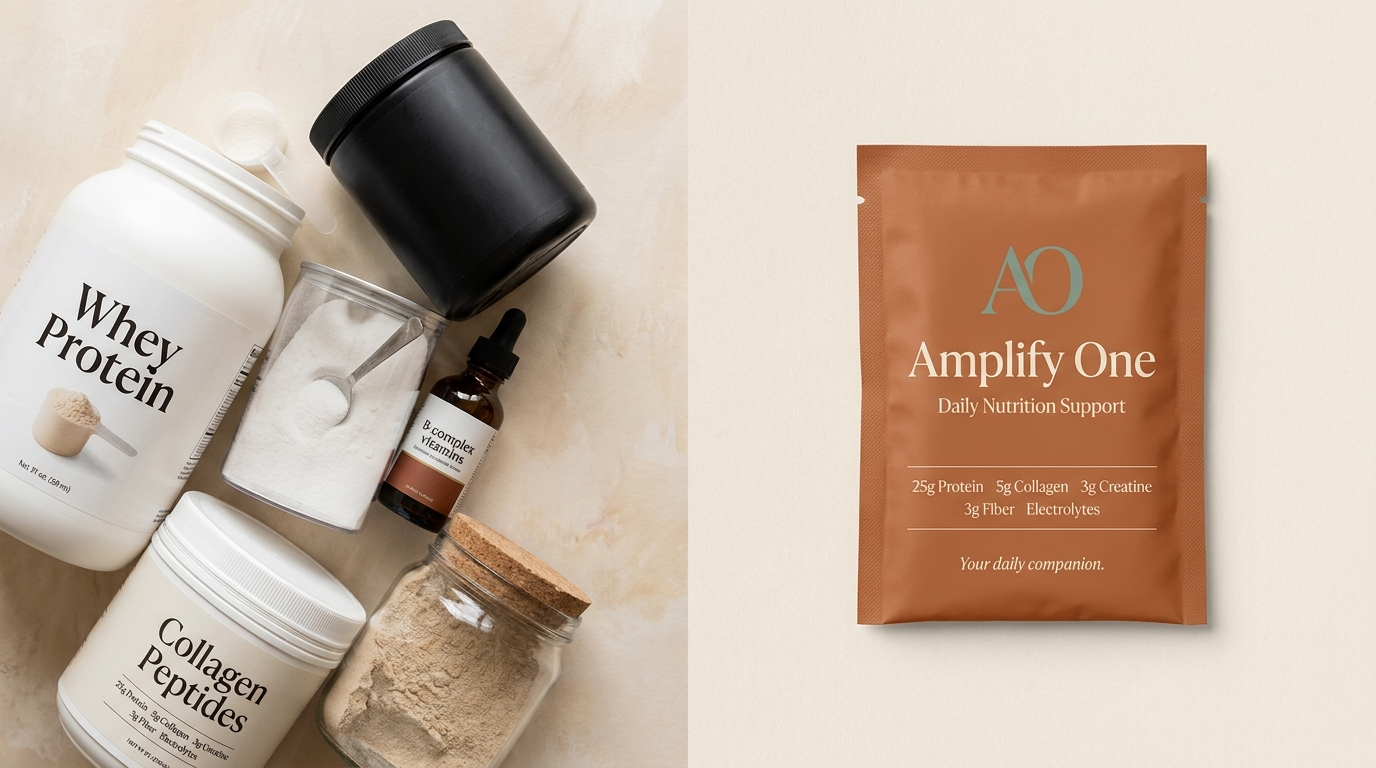
Here's the practical issue. To cover all five categories above with separate products, you're looking at:
- 1 whey protein tub ($30 to $60 per month)
- 1 creatine container ($20 to $40)
- 1 electrolyte product ($25 to $50)
- 1 B-vitamin complex ($20 to $50)
- 1 fiber supplement ($15 to $30)
That's $110 to $230 per month and 5 separate routines to remember. Most GLP-1 users abandon stacks like this within a few weeks because consistency drops when complexity rises.
This is the entire reason we built Amplify One. One sachet, every gram on the label, the five categories the research actually supports. Built for the GLP-1 user who wants to do this right but cannot reasonably manage a 5-bottle stack.
The Bottom Line
If you're on a GLP-1, the supplements with real research support are:
- Whey protein isolate at 25 to 30 grams daily
- Creatine monohydrate at 3 to 5 grams daily
- Electrolytes (sodium, potassium, magnesium) at clinically meaningful doses
- Methylated B-vitamins (B12 as methylcobalamin, B6 as P-5-P, folate as 5-MTHF)
- Soluble fiber at 3 to 5 grams daily
Everything else is optional. These five close the nutrition gap that GLP-1 medications create. They are the foundation. Whatever stack you choose, get these right first.
Frequently Asked Questions
Sources
- Cava E, Yeat NC, Mittendorfer B. "Preserving Healthy Muscle during Weight Loss." Advances in Nutrition. 2017;8(3):511-519.
- Kreider RB, Kalman DS, Antonio J, et al. "International Society of Sports Nutrition position stand: safety and efficacy of creatine supplementation in exercise, sport, and medicine." Journal of the International Society of Sports Nutrition. 2017;14:18.
- National Institutes of Health Office of Dietary Supplements. "Magnesium Fact Sheet for Health Professionals."
- Moll S, Varga EA. "Homocysteine and MTHFR Mutations." Circulation. 2015;132(1):e6-e9.
Daniel Showman
Founder of Amplify One. Writing about GLP-1 nutrition from the research, and from experience.
More articles →