Research
Creatine on Ozempic: Should You Take It? The Research
By Daniel Showman · Updated Jun 6, 2026 · 8 min read
Creatine has a branding problem. For decades it was marketed almost exclusively to bodybuilders and college athletes, which made it feel niche and intimidating to everyone else. The science has long since moved past that positioning, but the perception hasn't fully caught up.
For people on a GLP-1, creatine might be one of the most important supplements you're not taking. Here's why the research supports it, what dose actually matters, and which forms to avoid.
What Creatine Actually Does
Creatine is a molecule your body produces naturally, primarily in muscle tissue and the brain. Its main job is to help regenerate ATP, the energy currency your cells use for every action they perform.
When you contract a muscle, ATP is used and broken down. To use that muscle again, your body has to remake more ATP. Creatine speeds up that regeneration. The more creatine stored in your muscle tissue, the faster you recover between efforts.
This is why creatine has obvious appeal for athletes. More available ATP means stronger contractions and faster recovery between sets.
But the benefits aren't limited to athletic performance. Creatine also:
- Supports muscle protein synthesis (the process of building and maintaining muscle tissue)
- Helps preserve lean mass during periods of reduced food intake
- Plays a role in brain energy metabolism (creatine is concentrated in the brain too, not just muscles)
- May support cognitive function, particularly under stress or sleep deprivation
For GLP-1 users, the last three benefits are far more relevant than the athletic performance angle.
What the Research Actually Says
The International Society of Sports Nutrition published a position stand on creatine in 2017 that remains the gold standard reference. The opening statement is direct: creatine monohydrate is "the most effective ergogenic nutritional supplement currently available to athletes with the intent of increasing high-intensity exercise capacity and lean body mass during training" (1).
That language is important. The ISSN position is based on hundreds of peer-reviewed studies spanning more than three decades of research. Few supplements have anywhere near that level of evidence.
Key findings from the research base:
Muscle preservation in calorie deficit. A 2003 study in Medicine and Science in Sports and Exercise showed that creatine supplementation during a calorie-restricted diet helped preserve strength and lean mass compared to placebo (2).
Resistance training amplification. Creatine consistently enhances strength and lean mass gains when paired with resistance training. The effect is well-documented across multiple meta-analyses.
Safety across age groups. Long-term studies have shown creatine to be safe in healthy adults across a wide age range. There is no evidence of kidney, liver, or cardiovascular harm at typical doses in people with normal organ function (1).
Brain effects. A growing body of research suggests creatine supports cognitive function, particularly in situations involving sleep deprivation, mental fatigue, or aging. The brain uses creatine for the same ATP regeneration as muscle tissue.
Why GLP-1 Users Specifically Benefit
For someone on a GLP-1, three creatine benefits are particularly relevant:
1. Lean mass preservation during weight loss. As covered in our article on muscle loss during GLP-1 treatment, up to 45 percent of weight lost on semaglutide can come from lean mass rather than fat. Creatine, paired with adequate protein and resistance training, is one of the most evidence-backed interventions for shifting that ratio toward more fat loss and less muscle loss.
2. Strength preservation when food intake is reduced. Many GLP-1 users notice their strength dropping within the first few weeks of treatment. They blame the medication, but the actual mechanism is often reduced creatine intake (dietary creatine comes primarily from meat) combined with reduced overall calorie intake. Supplementation restores baseline creatine levels.
3. Mental clarity and energy. Many GLP-1 users report brain fog and reduced mental sharpness. Some of this is multi-causal (low B-vitamins, electrolyte imbalance, poor sleep), but creatine plays a role here too. The brain uses about 20 percent of total daily ATP production, and creatine availability affects how efficiently neurons can regenerate that energy.
The Dosage That Matters
This is where most supplement products fail GLP-1 users.
Clinical research on creatine uses doses of 3 to 5 grams of pure creatine monohydrate daily. That's the dose where the benefits described in the studies actually appear.
Walk down any supplement aisle and you'll see products labeled "creatine complex" or "creatine blend" containing 500 milligrams or 1 gram of creatine mixed with other ingredients. These are typically marketed to people who don't know the dose that matters. At 500 mg to 1 g daily, you cannot reasonably expect the effects the research describes.
A simple way to evaluate any creatine product:
- Does the label show pure creatine content in grams (not milligrams)?
- Is the daily serving 3 grams or more?
- Is it creatine monohydrate specifically?
If the answer to any of those is no, the product probably will not produce the benefits you're looking for.
Loading Is Not Necessary
Older creatine protocols recommended a "loading phase" of 20 grams per day for 5 to 7 days, followed by a maintenance dose of 5 grams daily. This approach was based on getting muscle creatine stores saturated as quickly as possible.
Updated research has shown that loading is unnecessary for most people. Taking 3 to 5 grams daily for 3 to 4 weeks produces the same level of muscle saturation as loading, just slightly slower (1).
For most GLP-1 users, skip the loading. Take 3 to 5 grams daily consistently. Within 3 to 4 weeks, your muscle stores will be fully saturated, and you'll see the benefits the research describes.
Forms and What to Avoid
Walk into any supplement store and you'll see creatine sold in multiple forms:
- Creatine monohydrate
- Creatine HCl
- Creatine ethyl ester
- Buffered creatine (Kre-Alkalyn)
- Creatine nitrate
- Creatine magnesium chelate
The marketing for non-monohydrate forms usually claims better absorption, less bloating, or faster effects. The research does not support these claims at meaningful levels.
Stick with creatine monohydrate. It has decades of safety data, the most research support, and is significantly cheaper than the novel forms. Look for "micronized" creatine monohydrate, which mixes better in liquid but is otherwise identical.
What to avoid:
- "Creatine complexes" or "blends" at sub-3-gram doses
- Novel forms without compelling research backing the cost premium
- Pre-workout products that include creatine alongside high-stimulant ingredients (especially problematic for GLP-1 users who may already have nausea sensitivity)
Safety Concerns and the Kidney Myth
The most common online myth about creatine is that it damages kidneys. This is not supported by the research.
The myth originated from a single case report in 1998 of a young man with pre-existing kidney disease who developed kidney problems on creatine. That single report has been cited thousands of times despite never being reproduced. Subsequent studies in healthy adults, including long-term studies tracking creatine users for years, have found no evidence of kidney harm at standard doses (1).
The legitimate concern: if you have pre-existing kidney disease, talk to your prescribing clinician before starting any new supplement, including creatine. For healthy adults with normal kidney function, the safety profile is excellent.
Other minor concerns to know about:
Water retention. Creatine draws water into muscle tissue, which can cause a 1 to 3 pound weight gain in the first few weeks. This is intramuscular water, not fat. It typically stabilizes after the first month.
GI sensitivity. A small percentage of people experience mild stomach discomfort when first starting creatine, especially at higher doses. Taking 3 grams daily (instead of 5) and consuming with food usually resolves it.
Nausea on a GLP-1. Some GLP-1 users have heightened nausea sensitivity. Take creatine with food, never on an empty stomach. If nausea persists, reduce to 3 grams daily and increase gradually.
The fix isn't a mystery. It's just inconvenient. Hit your protein. Replace your electrolytes. Take active form B-vitamins. Add creatine. Get enough fiber. Every single day.
How Creatine Fits in the Full Supplement Stack
If you've read our article on the five supplements GLP-1 users actually need, creatine is the second category on that list. It fits alongside:
- Whey protein isolate (25 to 30 g daily) — covered separately
- Creatine monohydrate (3 to 5 g daily) — this article
- Electrolytes (sodium, potassium, magnesium) — covered separately
- Methylated B-vitamins — covered separately
- Soluble fiber — covered separately
Each one addresses a different nutrition gap that GLP-1 treatment creates. Creatine specifically addresses the strength and lean mass preservation gap that emerges within weeks of starting the medication.
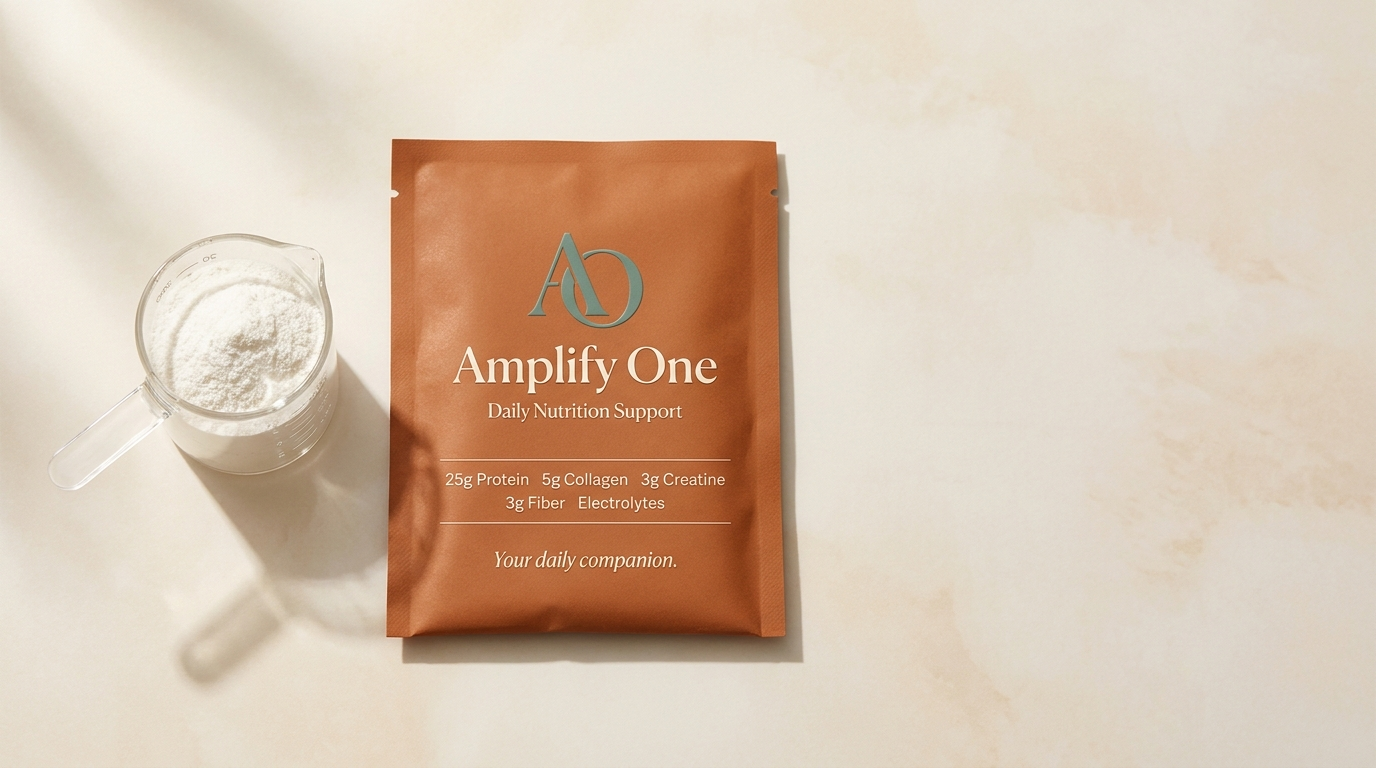
This is why Amplify One includes 3 grams of pure creatine monohydrate in every sachet. Not 500 mg of "creatine complex." Not a token amount stacked alongside dozens of other ingredients. The clinically supported dose, paired with the other four categories the research backs, in a single daily routine.
The Bottom Line
Creatine is one of the most-studied supplements in nutrition, with strong evidence supporting its use for muscle preservation during calorie deficits. For GLP-1 users specifically, the case is even stronger:
- Take creatine monohydrate, not novel forms
- Take 3 to 5 grams daily
- Take it consistently — loading is unnecessary
- Take it with food, not on an empty stomach
- Pair it with adequate protein and resistance training for full effect
The safety profile is excellent in healthy adults. The kidney damage concern is a myth that does not survive scrutiny of the actual research. If you have pre-existing kidney disease, talk to your clinician first.
For everyone else, creatine is one of the highest-leverage daily supplements you can add to your GLP-1 protocol. The cost is low. The research is overwhelming. The downside risk is minimal.
It's not just for athletes anymore. It might be one of the most important supplements for anyone in a calorie deficit.
Frequently Asked Questions
Sources
- Kreider RB, Kalman DS, Antonio J, et al. "International Society of Sports Nutrition position stand: safety and efficacy of creatine supplementation in exercise, sport, and medicine." Journal of the International Society of Sports Nutrition. 2017;14:18.
- Volek JS, Mazzetti SA, Farquhar WB, et al. "Physiological responses to short-term exercise in the heat after creatine loading." Medicine and Science in Sports and Exercise. 2001;33(7):1101-1108.
Daniel Showman
Founder of Amplify One. Writing about GLP-1 nutrition from the research, and from experience.
More articles →